Save On Foundation And Drainage Projects
- Home
- /
- Concrete vs. Steel vs. Hybrid Piers
Not every foundation repair requires the same solution. We evaluate your home’s foundation, soil conditions, and structural needs before recommending the right pier system. Understanding the differences between concrete, steel, and hybrid piers can help you make a more informed decision about protecting your property.
Foundation piers are used to stabilize structures that have experienced settlement or movement. When soil beneath a property shifts or loses its ability to support weight evenly, piers provide additional support by transferring the load to more stable ground. This process helps reduce further movement and restores structural balance.
In North Texas, expansive clay soil is a major factor in foundation issues. As moisture levels change, the soil expands and contracts, placing pressure on foundations. Over time, this can lead to uneven settlement. Because surface soil is often unstable, deeper support systems are needed to provide consistent stability. Pier systems are designed to reach more reliable soil layers and create a stronger foundation base.

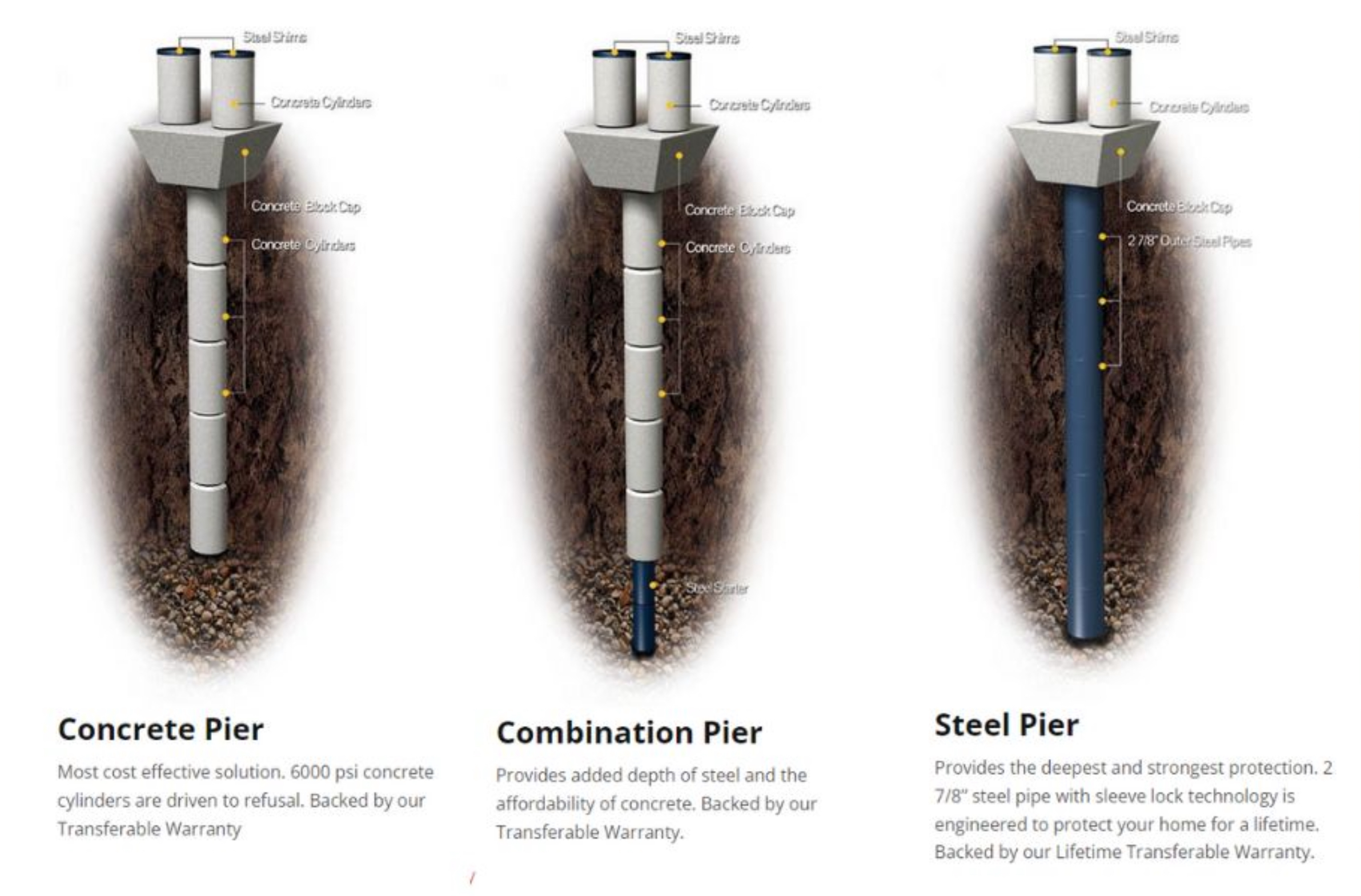
Concrete piers are a widely used method for stabilizing foundations. They are installed by drilling or excavating into the ground and placing reinforced concrete cylinders beneath the foundation. These piers provide support by distributing the weight of the structure across more stable soil layers.
Concrete piers are often used in residential applications where soil conditions allow for effective support at moderate depths. They are a practical solution for many properties experiencing typical foundation settlement.
Advantages include durability and a long history of use in foundation repair. Concrete piers can provide consistent support when properly installed and are suitable for a wide range of homes. However, they may not reach as deep as other systems, which can limit their effectiveness in areas with highly unstable soil.
Benefits
Steel piers are designed for deeper foundation support and are often used when settlement is more severe. These piers are driven into the ground until they reach load-bearing soil or stable strata. This allows them to bypass unstable surface soil and anchor the structure to stronger layers below.
Steel piers are installed with precision equipment that ensures accurate placement and depth. Because they are driven deeper than many other systems, they are well suited for properties where soil conditions vary significantly or where deeper support is required.
Their strength and load-bearing capacity make them a strong option for structures with greater weight or more advanced settlement issues. While they may involve a higher upfront investment, they provide reliable long-term performance in challenging conditions.
Benefits
Hybrid piers combine elements of both concrete and steel systems to create a customized solution. This approach allows for flexibility in addressing varying soil conditions and structural requirements. By using different materials together, hybrid systems can provide support at multiple depths and adapt to complex foundation issues.
A hybrid approach is often used when a property requires more than one type of support system. For example, certain areas of a foundation may benefit from deeper steel support, while others may be stabilized effectively with concrete piers. This combination allows for a more tailored repair strategy.
Hybrid systems are designed to match the specific needs of each property, providing balanced support that addresses both shallow and deep soil conditions.
Benefits
The best foundation repair solution depends on several factors, including your home’s construction, soil conditions, and the severity of settlement. No single pier system works for every situation. Each property presents unique challenges that require careful evaluation.
We assess each property individually to determine which system will provide the most reliable long-term results. By considering structural needs, soil behavior, and engineering recommendations, we can recommend a solution that supports your foundation effectively.
We focus on providing foundation repair solutions that match the specific needs of each property. Our approach is built on clear communication, practical recommendations, and consistent workmanship.